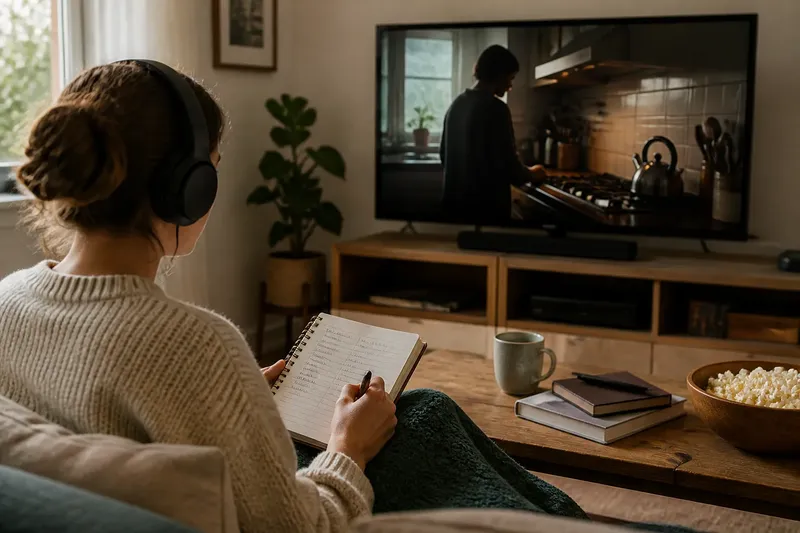
Two Character Journals, Two Different Questions
Use two character journals to separate what a film character wants now from what they avoid admitting, then choose the prompt that reveals motive.
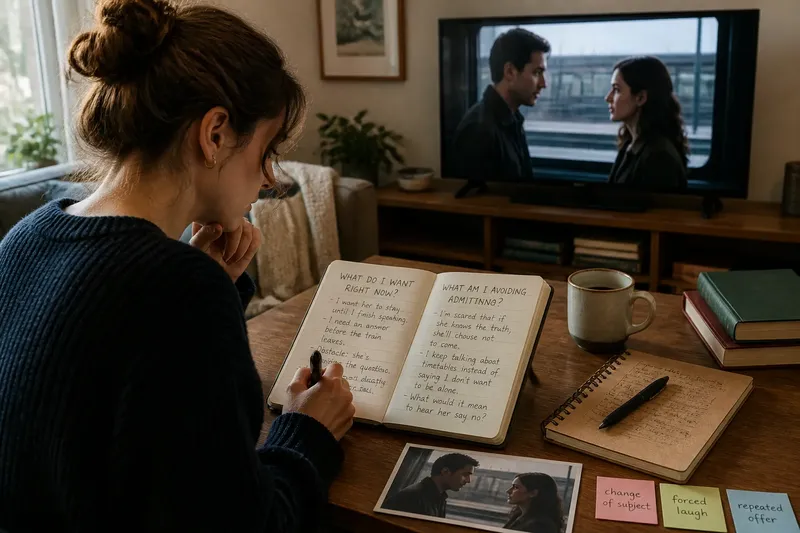
Two character journals can turn one film scene into two sharply different writing prompts: one asks what the character wants right now; the other asks what they are avoiding admitting. Choose the first when a character’s next move is unclear, and the second when their words seem out of step with their behaviour. Each question reveals a different kind of motive.
Use this decision guide after watching a fictional film, or after replaying a scene in your mind. You do not need to decide what the character “really” thinks. Treat each journal as an imaginative lens, make your interpretation visible on the page, and leave room for another reading.
Choose by the scene
Start with the moment that caught your attention. It might be a character asking for help, changing the subject, lingering by a doorway or agreeing to a plan too quickly. Ask what feels missing from your understanding.
- Choose the immediate-desire journal if you cannot tell what the character is trying to get, change or prevent in the scene. It is also a good fit when you want to continue the action in a plausible direction.
- Choose the avoided-admission journal if the character’s visible action seems to conflict with what they say, or if they repeatedly circle a subject without naming it. This prompt helps you explore pressure beneath the dialogue.
- Use both in sequence if the character’s stated aim is clear but still feels incomplete. Write the immediate want first, then ask what that want might help the character avoid facing.
For a scene with very little dialogue, begin with desire. A silent action may still serve a straightforward aim: getting away, staying close, keeping something hidden or waiting for a response. For a scene full of polished explanations, evasions or jokes, the avoided-admission question may offer more room to write.
Neither prompt is a verdict on the film. A character may have several motives, and the scene may deliberately leave them unresolved. Your page is a place to test an interpretation, not to settle the character’s meaning for everyone.
Journal immediate desire
Write as the character at the point where the scene begins. Keep the question close to the action: What do I want to happen before this moment is over? The answer should be concrete enough that another person could notice whether it happens. “I want to be happy” is too broad; “I want her to stay until I finish speaking” gives you something to write towards.
Try these prompts:
- What am I trying to make the other person do, understand or stop doing?
- What would count as a small win in this scene?
- What do I want to happen next, even if I would not say so aloud?
- What am I doing to move the scene towards that outcome?
- What obstacle is in front of me right now?
Write a short entry in the first person, using present tense if it helps. Include the character’s immediate aim, the obstacle and one action they are considering. You might write, “I need him to answer before the train leaves. I keep asking about the timetable because I cannot ask whether he intends to come with me.” The first sentence identifies a practical aim; the next lets you decide how the character pursues it.
Then return to the film’s observable details. What did the character actually say or do? Which detail supports your imagined aim, and which one complicates it? A sharp reply might look like an attempt to end the exchange, but it could also be a bid to regain control. Note the alternative rather than writing it away.
This journal is especially useful when you want to create a next beat. If the character wants an answer and cannot get one, the following moment might involve another question, a retreat or a change of tactic. Choose the action that fits the character as you have imagined them; do not force a dramatic turn just to keep the writing moving.
Journal avoided admission
Choose this question when the character appears to be managing what others can see: What am I avoiding admitting, even to myself? It invites an interpretation beneath the spoken aim, but it should still grow from the scene. A character who keeps tidying a table while a visitor waits might be avoiding a conversation, or avoiding the possibility that the visitor will leave. Pick the reading that best fits the behaviour you noticed.
Try these prompts:
- Which subject do I keep replacing with a safer one?
- What would become harder if I named what I feel?
- What detail in my behaviour contradicts my explanation?
- What do I fear another person would do with the truth?
- What sentence can I nearly write, then cross out?
Let the entry hesitate. A sentence can begin confidently and then qualify itself: “I am only asking him to stay because the road is dangerous. I mean, I do not want him to leave before I have decided what to say.” This is a possible fictional reading, not a hidden fact about the character. Its value lies in the tension between the explanation and the correction.
Say you have watched a fictional scene where a character insists that a friend take a spare key, then immediately jokes about the friend’s poor sense of direction. In an immediate-desire entry, you might write that the character wants the friend to accept the key and remain nearby. In an avoided-admission entry, you might explore whether the joke deflects from fear of separation. The first route points towards an action; the second offers a possible emotional reason for it. Either interpretation should stay open to the scene’s other clues.
Keep the writing grounded by naming the cue that prompted your reading: the change of subject, the forced laugh, the repeated offer or the sudden silence. If you cannot name a cue, mark the idea as a possibility and avoid treating it as established character history.
Match the prompt to your aim
Use immediate desire when you want to understand the scene’s movement. It helps you ask what the character is attempting, what stands in the way and what they might do next. It is a strong choice for a scene that feels static because you have not yet identified what either person wants from the exchange.
Use avoided admission when you want to explore subtext. It suits a character who offers an explanation that feels too smooth, changes the subject at a revealing moment or repeatedly behaves against their stated intention. The prompt can uncover a possible contradiction without requiring you to write a diagnosis or assign a single hidden truth.
Choose both when you can already state the visible aim but suspect it serves another purpose. Keep the entries separate rather than blending them into a single account. That lets you compare the character’s practical objective with the pressure you imagine underneath it.
If you are writing for the character’s voice, the desire journal often gives you a usable first line because it begins with something the character is trying to obtain. If you want to write a private, conflicted passage, the avoided-admission journal may give you a useful opening. Neither choice is inherently deeper. A plain, immediate want can reveal more than an elaborate theory about what a character secretly feels.
Keep two readings distinct
When you use both journals, label them with the questions rather than a judgement such as “truth” and “lie”. A character’s declared want may be sincere even if it is incomplete. Likewise, a suspected avoidance may come from your reading rather than from anything the film confirms.
Write each entry in a different direction. The first can move towards an outcome: get the letter back, secure an apology, keep the meeting going. The second can move around a difficult admission: what the character fears would change if they asked directly, what they do not want the other person to notice, or what they cannot yet put into words.
Afterwards, compare one sentence from each page. Ask whether the hidden pressure changes the meaning of the immediate aim, or whether both can be true at once. A character might genuinely want someone to stay and also avoid admitting how much that person’s departure would hurt. You do not have to choose a winner; the combination may be the most useful interpretation.
Questions about character journals?
How long should each entry be?
Write enough to name the motive, its scene cue and one possible action. A few focused sentences can be more useful than a full page that repeats the same interpretation.
Can I write about a character I dislike?
Yes. You can investigate what the character wants without approving of their choices. Keeping the journal in first person may help you understand the character’s reasoning while still leaving your own judgement intact.
What if I cannot identify an avoided admission?
Do not invent certainty. Write that the character may be avoiding something, list the behaviour that raised the question and leave the answer open. You can return to the immediate-desire prompt instead.
Can I use the method for a scene I have only partly watched?
Yes, as a prompt for your own creative reading, but treat the missing context as a limit. Focus on what is visible in the scene and avoid making claims about the character’s full history or motives elsewhere.
Leave room for revision
Close the page with one question, not a verdict: What would I need to notice in another scene to change this reading? That might be a repeated gesture, a different response to the same person or a moment when the character finally asks for what they want directly.
For a quick writing session, choose the prompt that answers the gap you actually have. If the action is hard to follow, write from immediate desire. If the dialogue feels evasive, explore the avoided admission. If both are visible, keep both entries brief and compare them. Two character journals are most useful when they produce distinct possibilities, and when you can revise those possibilities as the film gives you more to notice.