How to Build a Story Around a Single Deadline
Build a story around a single deadline: make each scene change the character’s options, sharpen the pressure and lead to a clear, visible choice.

A deadline gives a story a visible source of pressure: something must be done before a specific event, and each delay changes what remains possible. To build a story around a single deadline, choose the event first, then make every scene alter the character’s options rather than simply announce that time is passing.
Choose the deadline
Use an event the reader can picture: a theatre curtain rising, a ferry leaving the harbour, a council hall closing for the night. The event should matter because of what the character needs to do before it, not because a clock is mentioned repeatedly.
Keep the task specific. “Fix everything before the meeting” gives you little to stage. “Get the signed permission form to the caretaker before the hall locks” creates a destination, an obstacle and a consequence the reader can understand.
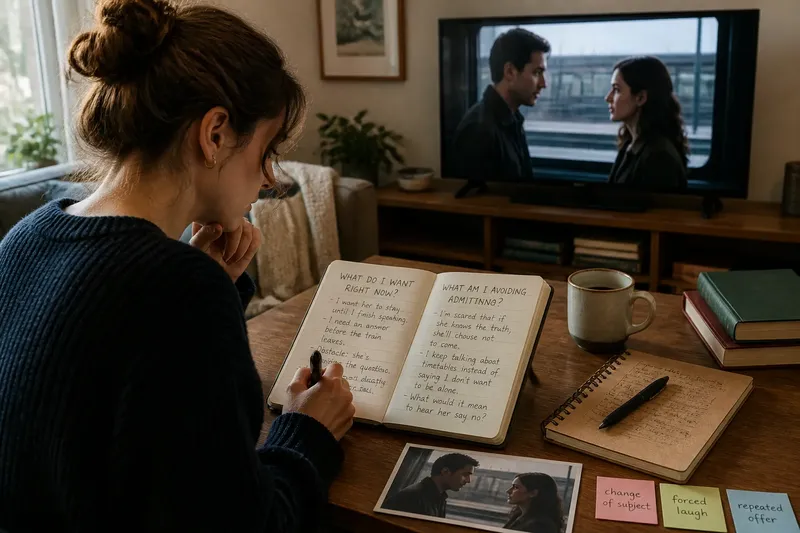
For a film-inspired prompt, notice how a fictional film uses an approaching event to organise action. Borrow the pressure pattern, not its characters, dialogue or plot. Invent a different task and let your own character’s priorities shape the outcome.
Map changing options
List the choices available to the character at the start, then decide how each major scene changes them. A scene should close one route, open another or make an existing route harder to take. If a scene only repeats that the deadline is near, cut it or give it a consequence.
- Task: If the goal can be stated as a concrete action, keep it; if it needs several explanations, narrow it to one immediate task.
- Deadline event: If the event has a clear arrival or closure, use it; if it can drift without consequence, choose a firmer occasion.
- First route: If the character has a plausible first attempt, show it; if the attempt is arbitrary, give them a reason to choose it.
- Obstacle: If it changes access, information or trust, keep it; if it merely delays the character, replace it with a consequential barrier.
- Cost: If failure affects something the character values, make that cost legible; if the cost is abstract, connect it to a person, promise or opportunity.
- Alternative: If a second route exists, state what it demands; if no route remains, decide whether the character must ask for help, sacrifice something or accept failure.
- Final choice: If the ending requires a decision, stage it before the deadline; if the result depends on luck alone, give the character an action that influences it.
These checks are for the outline, not a rule that every story needs a complicated chain of obstacles. A short story may need only a failed attempt, a difficult alternative and a final decision.
Make pressure visible
Give the reader signs of progress and interruption that belong to the setting. A caretaker stacking chairs, a queue moving towards a counter or a train announcement can show the deadline approaching without a character checking a watch in every scene.
Let pressure affect behaviour. A character might stop explaining, ask someone they distrust for help or abandon a careful plan. Those actions make urgency visible and reveal what the character values.
Not worth the effort: adding repeated countdowns or elaborate timekeeping if neither changes what the character can do. One clear signal of the approaching event is stronger than a string of decorative reminders.
Test the story shape
How do I choose a story deadline?
Pick a scheduled or unavoidable event that matters to the character’s immediate goal. Make clear what must happen before it and what becomes harder or impossible afterwards.
Does a deadline story need a clock?
No. A closing shop, a departing bus or a guest arriving can mark the limit. Use a clock only if watching the time changes the character’s decisions.
How many obstacles should I include?
Use enough obstacles to force meaningful changes in approach, not a fixed number. If two scenes create the same delay and choice, combine them or give one a different consequence.
Can the character miss the deadline?
Yes, if missing it produces a clear result and the character’s choices still matter. The ending can focus on what they do with that result rather than treating success as the only satisfying outcome.
Work through one outline
Say you are inventing a story about Mara, who needs to deliver a signed permission form before a neighbourhood hall closes for the evening. These are made-up details for the example. At the start, Mara has the form but the signer is at a nearby allotment; she plans to get the signature and walk straight to the hall.
First, Mara reaches the allotment and learns that the signer has left. The direct route is gone, so she asks the allotment caretaker to pass on a message. Next, the caretaker points out that the signer is helping at a community kitchen, which gives Mara a new place to try but costs her the time she intended to use for the walk. At the kitchen, the signer agrees but notices that the form is missing a required witness.
Mara now has a choice: carry the incomplete form to the hall and explain, or ask a neighbour who knows the group to witness the signature. She asks, the neighbour agrees, and they walk together to the hall. In this invented outline, the expected observable result is that Mara arrives with a complete form and has had to rely on someone she usually avoids. If the neighbour refuses, the alternative is to arrive with the incomplete form and make an honest request for an extension; either ending follows from a choice rather than a convenient accident.
Draft the decisive scenes
Write the first attempt, the moment the original route fails and the final decision as separate scenes. For each one, note the character’s goal, the obstacle and the option that remains afterwards. This gives the middle a practical shape while leaving room for discovery in the prose.
Then read the scenes in order and ask whether each changes the situation. If the same obstacle appears twice without changing the available choices, revise one scene. If the final result arrives without a difficult action from the character, make the last decision more consequential.
A deadline works best when it presses on a choice rather than serving as a loud background timer. Keep the event concrete, let obstacles alter the available routes, and make the character’s final action show what they are willing to risk or ask for.