A Rainy Afternoon Film Memory Page
A rainy afternoon film memory page helps you keep a film’s colour, sound and unanswered question without retelling its plot or losing its afterglow.
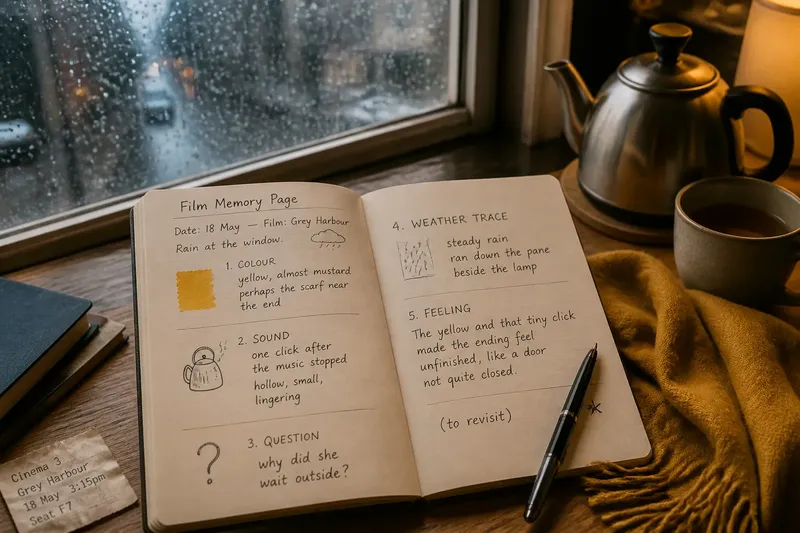
A rainy afternoon film memory page keeps a film’s afterglow in three small details: one remembered colour, one sound and one unanswered question. Make it soon after the credits, while rain taps the window or clouds the light, and let those details stay separate from the plot.
Use any notebook, a loose sheet or a notes app. The point is not to produce a polished review. It is to make a quiet keepsake that can bring back the texture of watching, even when the sequence of events has faded.
1. Set a small boundary
Give the page a date, the film’s title and a simple note about the afternoon, such as “rain at the window”. Then leave a little space for each of the three prompts. A small boundary makes the page feel finishable; a blank page with no limits can tempt you to recap every scene.
Keep the page to one sitting and one viewing. If you watched only part of the film, say so rather than filling gaps from memory. You can use a pencil, a favourite pen or a single coloured marker, but there is no need to decorate before you know what you want to keep.
2. Choose one colour
Write the colour that returned to mind first. It might belong to a coat, a room, a stretch of sky or an overall cast of light. Be precise enough to make it yours: “dull green like the inside of a glass bottle” carries more of your perception than “green”.
Do not turn this into an inventory of every striking shade. One colour gives the memory a focal point, while a list of costumes and backgrounds starts to resemble a scene-by-scene report. If the image is uncertain, mark it as uncertain: “perhaps a copper light near the end”. The page records what you recall, not what a camera analysis would confirm.
3. Listen for one sound
Record a sound as you remember hearing it: a low musical note, shoes on a hard floor, a door settling, wind against a window. You can add a few words about its quality—hollow, brittle, distant, warm—without trying to identify its source.
Silence can be a sound worth keeping, too. If the moment that stayed with you was a sudden absence of music, write that down and note what the quiet seemed to make room for. Avoid reconstructing the entire soundtrack. One sound, or one remembered silence, is enough to open the door back into the viewing.
4. Leave a question open
Write one question the film left with you, without answering it on the same line. It can concern a character’s motive, a choice, a strange image or your own response. “Why did I trust the narrator?” is more useful here than “What happened next?”, which invites a plot recap.
Let the question remain genuinely unresolved. You are not required to interpret the film, settle a disagreement or look up an explanation. A question can be a keepsake precisely because it preserves the thought you were still carrying when the credits ended.
5. Add a weather trace
Give the afternoon one brief mark of its own. Note whether rain was steady or intermittent, whether the room felt dim, or whether you heard traffic through a closed window. This is not a weather diary; it is a small cue that ties the page to the occasion of watching.
Keep the detail sensory and modest. “Rain ran down the pane beside the lamp” anchors the moment better than a paragraph about your whole day. If you watched somewhere other than home, record a simple surrounding detail, such as the soft murmur of a cinema foyer after the screening.
6. Link detail to feeling
After the colour, sound and question, add one sentence about the feeling they leave together. Keep it tentative: “The pale blue and the distant bell made the ending feel unfinished.” You are not declaring the film’s meaning; you are noting how these particular details settled in your memory.
Say you watched a fictional film on a wet afternoon and kept remembering a yellow scarf, a kettle’s click and the question of why a character waited outside. Your page might say: “Yellow, almost mustard; one click after the music stopped; why did she wait? The room’s rain made that pause feel longer.” That is enough to recall a response without retelling what the characters did before or after.
7. Close without polishing
Read the page once, correct anything you cannot understand later, then stop. You might add a small mark beside the question if you want to revisit it, but avoid turning the page into an assignment with research, ratings or a full review attached. A memory page should leave the film’s loose ends loose.
What is not worth the effort is chasing the exact shade, sound source or wording of a half-remembered line. Those details may shift, and that is part of remembering. Keep the uncertainty visible rather than interrupting a quiet ritual to verify every impression.
Questions for the page?
Should I write the film title?
Yes, if you want to recognise the page later. Add the title and viewing date as a small heading, then keep the rest focused on your sensory details.
What if no colour comes to mind?
Write “none clear” or describe the overall light as you remember it. Do not search through the plot for a colour just to fill the space.
Can I draw instead of writing?
Yes. A coloured patch, a wavy sound line or a question mark can carry the same three prompts, as long as you can tell what each mark means when you return to it.
When should I make the page?
Make it when you have a quiet moment after viewing, while a detail is still near. If the afternoon has moved on, write the small fragments you remember rather than trying to recreate the whole experience.
A rainy afternoon film memory page works best when it remains incomplete in the right way: one colour, one sound, one open question, and a trace of the weather that held them. Slip it into the notebook beside other viewing keepsakes, and let the next film have a fresh page of its own.